MYTH #4

MANUFACTURING MYTH SERIES

The Myth That Technology Replaces Workers

Automation is eliminating manufacturing jobs — technology replaces workers

REALITY

Advanced manufacturing institutes help workers adapt and upskill — working alongside technology, not against it

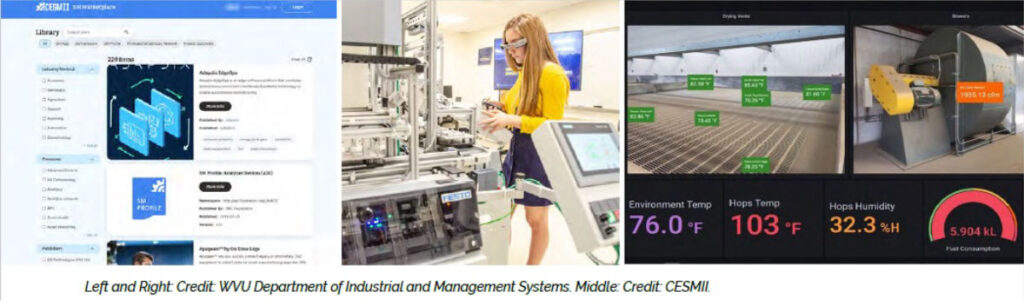
PICTURED HERE:

Worker operating smart manufacturing equipment, and CESMII dashboard. (Source: Manufacturing USA 2025 Report)

The Stereotype
Robots are taking factory jobs. Artificial intelligence is replacing human decision-making on the production floor. The more automation advances, the fewer workers manufacturing will need. This narrative has driven anxiety about the future of work for more than a decade — and it surfaces every time a new technology platform is introduced in an industrial setting.

The Reality
The evidence is more nuanced. Automation does change jobs — consistently, and often significantly. But the pattern in advanced manufacturing is that technology shifts what people do and how they contribute rather than eliminating the need for people. Repetitive, physically demanding, and hazardous tasks move to machines. Workers move into roles requiring technical judgment, programming, maintenance, process optimization, and quality oversight. In high-value manufacturing sectors, automation has generally been associated with higher wages and stronger demand for skilled workers — not fewer of them.

The challenge is transition: workers trained for one set of tasks need pathways into the new ones. This is the gap Manufacturing USA institutes are purpose-built to help address.
What the Network Is Doing

  • RAPID Manufacturing Institute (New York, NY) develops modular chemical process intensification technologies that automate and streamline chemical production — but in doing so, creates new categories of process engineering roles that did not previously exist. RAPID’s continuous processing approach converted one chemical dispersant process from batch to continuous, cutting capital costs 65% and operating costs 60% while requiring a more technically skilled operations team.
  • AFFOA — Advanced Functional Fabrics of America (Cambridge, MA) is commercializing fiber and fabric technologies — fabrics that sense, communicate, and respond — that represent an entirely new category of manufacturing. AFFOA’s work creates manufacturing roles in electronic textile production that require skills spanning materials science, electrical engineering, and precision manufacturing — jobs that simply did not exist a decade ago.
  • EPIXC — Electrified Processes for Industry without Carbon (Tempe, AZ) the network’s newest institute, is electrifying industrial process heating — a sector that accounts for roughly 25% of U.S. industrial energy consumption. Electrification of these processes introduces new control systems, new equipment categories, and new technical roles for the workers who operate and maintain them.
  • REMADE Institute (Rochester, NY) focuses on the integration of AI into recycling, remanufacturing, resource recovery and material optimization. To date, the Institute has invested in 23 AI integration projects, including those developing sorting technologies, evaluation technologies, assembly and disassembly operations technologies, design tools and identification assessment tools for remanufacturing, as well as design tools for recycling. Among REMADE’s goals for its AI Integration initiative are identifying applications where AI can be beneficial; providing guidance on best approaches, methods and tools for specific applications; piloting projects for demonstration; and developing training programs to support industry and workers.” You can learn more about our AI Integration initiative here: AI Integration – REMADE Institute


Why It Matters
The fear of automation is understandable — but misdirected when it leads workers and policymakers to avoid investment in manufacturing careers and capabilities. The answer to technology-driven disruption is not avoidance. It is investment in the pathways that allow workers to grow into the technical roles that automation creates. That is precisely what Manufacturing USA institutes exist to provide.

Manufacturing USA network FY2023: 216 education and workforce development projects (up 40% year over year); 150,700+ workers, students, and educators engaged. Source: NIST AMS 600-19.